
Riverine Walks: Sylvan Island
Dr. Norm Moline, Augustana professor emeritus of geography, will offer a Riverine Walk: "Sylvan Island Area: History, Recreation, and Sustainability."
Riverine Walk participants explore the Quad Cities through a series of guided walks. If you are curious about the terrain or difficulty of a walk, call River Action for more information, 563- 322-2969.
Riverine Walks: Dr. Tim Muir
Dr. Tim Muir, Augustana associate professor of biology, will present the Riverine Walk: "I'm freezing out here" about his research on turtle hibernation.
Riverine Walk participants explore the Quad Cities through a series of guided walks. If you are curious about the terrain or difficulty of a walk, call River Action for more information, 563- 322-2969.
Channel Cat Talks: Landscape Mosaic
Dr. Norm Moline, Augustana emeritus professor of geography, and Dr. Reuben Heine, Augustana associate professor of geography, will present the Channel Cat Talk "Landscape Mosaic."
The program also will be offered at the same time and place Aug. 14.
Channel Cat Talk participants tour the Mississippi River aboard the Channel Cat Water Taxi, while experts narrate. All Channel Cat Talks are from 9-10:45 a.m. Meet at the Riverbend Commons Dock, 2951 E. River Drive, Moline, Ill. Headsets are provided.
Channel Cat Talks are $14 per person.
Channel Cat Talks: Landscape Mosaic
Dr. Norm Moline, Augustana emeritus professor of geography, and Dr. Reuben Heine, Augustana associate professor of geography, will present the Channel Cat Talk "Landscape Mosaic."
The program also will be offered at the same time and place Aug. 16.
Channel Cat Talk participants tour the Mississippi River aboard the Channel Cat Water Taxi, while experts narrate. All Channel Cat Talks are from 9-10:45 a.m. Meet at the Riverbend Commons Dock, 2951 E. River Drive, Moline, Ill. Headsets are provided.
Channel Cat Talks are $14 per person.
Historical Society: Lustron homes
Brandon Tidwell, human resources generalist at Augustana and president of the Moline Preservation Society, will present a program on Lustron homes at a dinner meeting of the Rock Island Arsenal Historical Society.
Lustron homes were all-steel, prefab houses made from mid-1948 to mid-1950 as a solution to the post-World War II housing shortage. More than two dozen of the homes still exist in the Quad Cities.
The meeting is open to members and non-members. Those who wish to skip dinner and attend just the program portion of the meeting, starting at 7 p.m., may do so free of charge.
The menu will be soup, sandwiches, dessert, coffee, tea, and water for $11, including tax and tip. Please have your check or cash ready when you arrive. For reservations call Monica 563-650-4349 or Linda 563-355-6165 or email chiicaliinda@aol.com. Reservations are due by noon June 4.
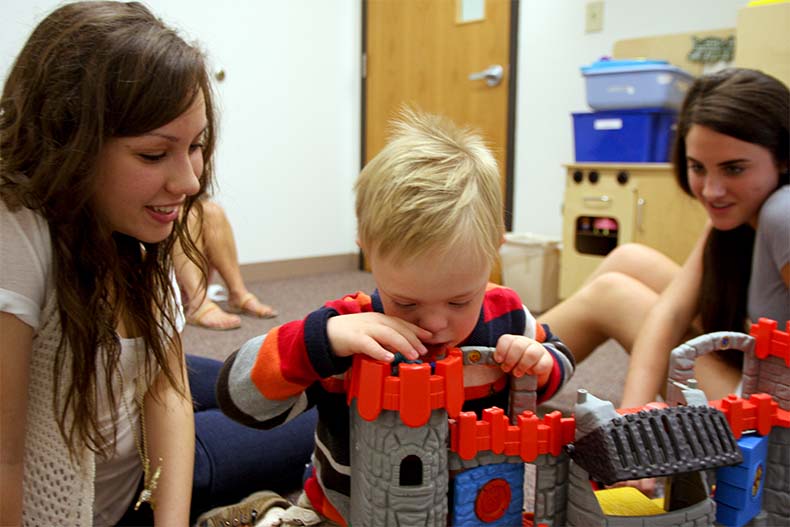
Students invited to observe at clinic
High school students who are interested in studying speech-language pathology or audiology are invited to observe at Augustana Center for Speech, Language, and Hearing this summer.

Augustana congratulates 630 graduates
Augustana College congratulated 630 new graduates May 20 in a ceremony at the TaxSlayer Center in Moline.
Opera: Songs of Survival
OperX Ensemble is joined by the Augustana Chamber Orchestra and the Jenny Lind Vocal Ensemble in a performance of "Brundibár," a children's opera by Jewish Czech composer Hans Krása.
Performances will be November 16 at 7:30 p.m., and November 17 at 2 p.m. and 7:30 p.m.
• Program
"Brundibár" was written in 1938 but was not performed until 1942 when it premiered at the Vinohrady Jewish Boy’s Orphanage in the Prague ghetto.
Krása had already been sent to the Terezín concentration camp where he was the musical director of the Freizeitgestaltung, a group of prisoners tasked with organizing cultural activities for the camp.
When the conductor of the original Prague production was sent to Terezín himself, he smuggled in a piano score to "Brundibár." From this and his own memory, Krása reconstructed the opera, taking into account the performing forces available to him in the camp.
Beginning with a performance on July 23, 1943, "Brundibár" was performed 55 times in the Terezín camp over the course of the next year and a performance was central to an International Red Cross visit to the camp in June 1944, during which the visiting delegation was deceptively shown a healthy and happy Jewish population.
As the war was nearing its close, Krása was taken on a transport that left Terezín on Oct. 16, 1944, and he was killed in a gas chamber at Auschwitz two days later.