
Symposium Day 2026 shares the power of story
What can a story do? For this fall's Symposium Day, Augustana’s campus spent a day exploring that question from different angles.
This year’s theme, The Power of Story, brought together the Augustana community to consider how stories shape what we believe, how we connect and how we imagine the world around us.
Stories are told through scientific papers, mathematical proofs, product pitches and political campaigns. Today, artificial intelligence raises questions about authorship and creativity.
This Symposium Day theme invited a cross-disciplinary exploration that included discussions of what stories get told and who gets to tell them.
Here are three sessions that offer a glimpse into the conversations from Symposium Day:
Keynote: Ken Liu, "The Art of Copying: The Future of Humanistic Art in the Age of AI"
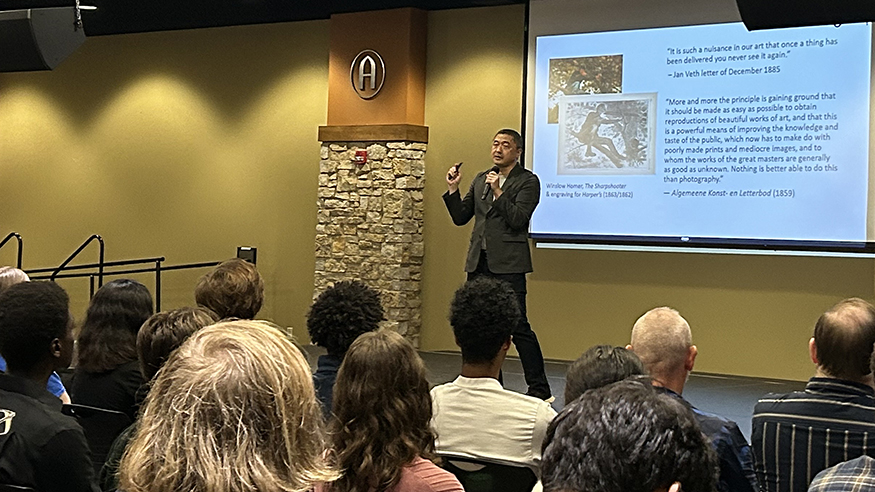
Is “AI art” meaningless slop, or the next evolution of visual culture?
Science fiction author Ken Liu examines the uses and misuses of AI in storytelling and art, drawing on history to consider how technology can change the way we create.
When printing presses replaced scribes and photography changed the work of engravers, art didn’t disappear. It changed. Engravers once helped reproduce paintings for a wider audience, but photography eventually took over that role. This allowed painters to explore new ways of seeing rather than focusing on simply reproducing what already existed.
Today, generative AI presents a similar crossroads. While pushing a button to generate bestsellers or images may be artistically uninspiring, commercial markets will naturally gravitate toward fast, cheap output. But true art isn’t found in the instant product. It lies in wrestling with the medium, shaping words, paint or sound, and growing through the process.
No artist begins with a single perfect conception. As Liu highlights, “We humans will always go into the realm or try to breathe new life into something, and machines will always be there trying to reproduce what is mere imitation.” While AI can reproduce commercial standards, human creation remains essential for copying the uncopyable.
From Homer to Nolan: The Timeless Power of "The Odyssey"
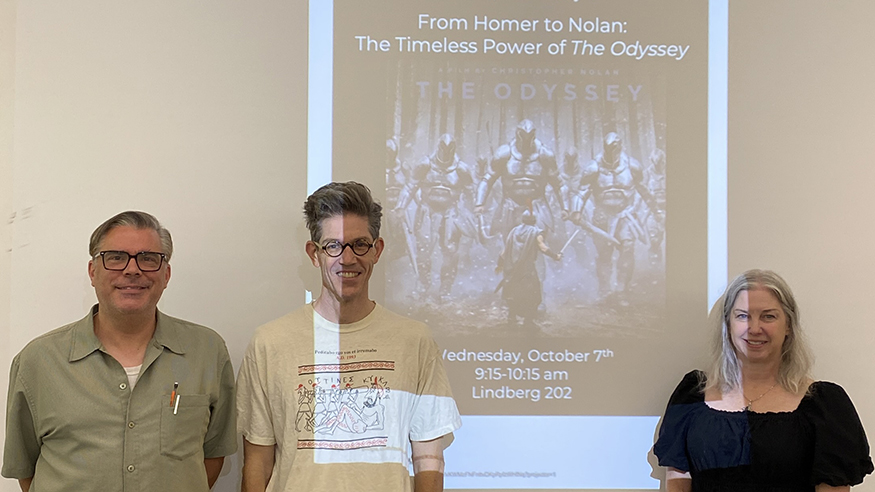
Augustana's Classics faculty led an open discussion of Christopher Nolan's "The Odyssey." Dr. Kristen Day, Dr. Mischa Hooker and Dr. Nick Dobson led the conversation, which looked at what the blockbuster keeps from Homer, what it leaves out and why a story nearly three thousand years old can still fill a theatre.
Dr. Dobson began with what he saw as the film's biggest omission. Odysseus is famously a trickster, yet he plays no tricks on screen. Homer's articulate and menacing Cyclops becomes a mumbling figure. As a result, the story loses the humor that comes from enjoying Odysseus's cleverness. Dobson also questioned the film's "Zeus's law." He noted that the idea of gods punishing people for wronging each other belongs to a later stage of Greek thought.
Dr. Hooker took a broader view and reminded the audience that even ancient authors reshaped this story. He suggested that Nolan's Odysseus is a man already changed by the war. He also saw merit in Zeus's law because it emphasizes reciprocity, a value rooted in Greek society. The "Sea Peoples" references are anachronistic, but he found the final reveal effective: the destruction comes from within.
Dr. Day praised the film's focus on trauma, which echoes Jonathan Shay's work and "Epic: The Musical." She called the IMAX visuals stunning and singled out the Circe scene and Samantha Morton's performance. She also hoped to see more depth given to the film's other women, including Lupita Nyong'o's Helen and Charlize Theron's Calypso. Returning to the symposium's theme, Day explained that the power of the Odyssey lies in its ability to give nearly everyone somebody to connect to, whether that is Penelope waiting for news, Telemachus missing his father or Argus the loyal dog.
The session was joined by students in the audience who presented their thoughts about the movie and how they perceived the message from the film.
Augie Film Awards Show
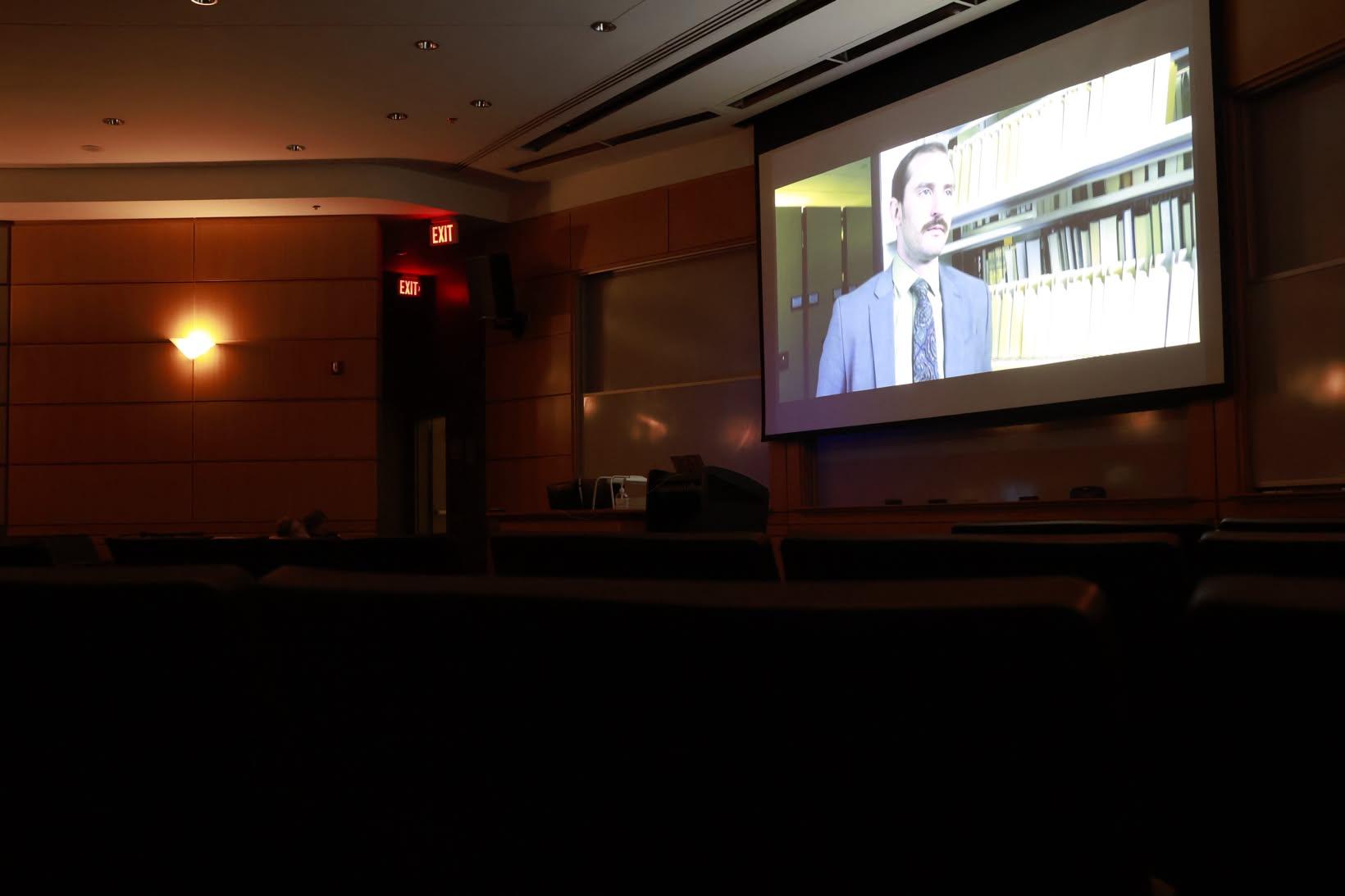
The Augie Film Awards Show brought students and Augustana's best filmmakers together in Olin Auditorium for an afternoon of short films, artistic horror, unexpected plot twists and a few good laughs. The films explored different ideas, from murder mysteries and psychological thrillers to adjusting to life on Earth as an alien.
The session started with “The Observer,” a murder mystery, followed by “Harvey,” a psychological thriller featuring Noah Johnson as Harvey. Another film followed a man who eats an owl and begins turning into something of an owl himself. It was the combination of these unusual stories that added to the variety of the afternoon.
“Blood Orange” focused on a murder and its aftermath, with a twist that had the audience gasp out loud. “The Alien, The Body of Stars” followed an alien who was not accustomed to Earth, even though his friends had already adjusted. “Night Shader” explored cyberbullying and had a really interesting turn of events at the very end.
There were also some lighter moments, including a funny rap-style skit and another involving cocaine and the IRS, which had a surprise turn of its own.=
After the screenings, the filmmakers joined a question-and-answer session with the audience. Much of the conversation focused on their thought processes, what inspired their stories and the experiences they had while making the films. Hearing about how their ideas came together made the afternoon even more enjoyable and gave the audience a chance to appreciate the people behind the stories.