
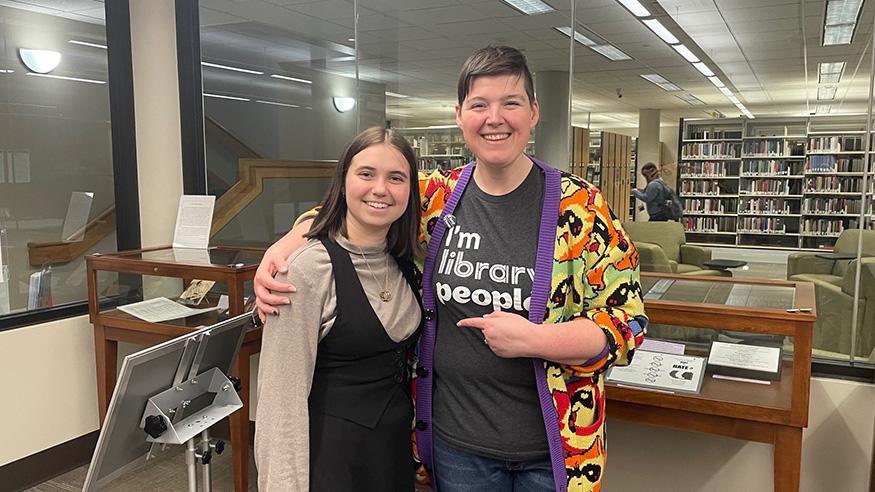
American Library Association President Sam Helmick visited Augustana to see "InQueering at Augustana: Why Joyful Memories Matter," an exhibit curated by Kat-Jean Glusick '26 as part of their Senior Inquiry for their women, gender, and sexuality studies major.
Student exhibit shares queer joy and memory at Augustana
When Kat-Jean Glusick ’26 first began digging through Augustana’s archives for their Senior Inquiry about queerness, they found plenty of pain — but not much joy.
“When I was initially looking in the archives, I noticed that there were a lot of traumatic memories surrounding queerness, but not many which were joyful,” Glusick said. “I wanted to encapsulate the full queer experience at Augustana, not just the traumatic memories, because when queer people are remembered as solely miserable, they are dehumanized in a way.”
“I wanted to encapsulate the full queer experience at Augustana, not just the traumatic memories, because when queer people are remembered as solely miserable, they are dehumanized in a way.”
Glusick, a double-major in English and women, gender, and sexuality studies, set out to change that imbalance. The result is “InQueering at Augustana,” a Special Collections exhibit that was open to the public from January-March.
To build the exhibit, Glusick, who hopes to become an archivist, turned to oral history. They conducted interviews with alumni, current and former faculty, and community members, assembling a collection of voices and memories that the written record had not preserved. The project also included a research trip to Iowa City, where Glusick, Special Collections librarian Micaela Terronez ’15, and other library staff reviewed collections at the Iowa Women's Archives and the LGBTQ+ Iowa Archives and Library.
What Glusick encountered in Special Collections is what archivists call archival silences, the intentional or unintentional gaps in the historical record that emerge, in large part, from the privilege and power of those who have historically had the means to be remembered. Terronez, who worked closely with Glusick on the project, sees examining those gaps as essential to the work of history.
“Because silences are embedded in the archives, we support students in looking critically at historical materials and assessing why gaps or silences exist,” Terronez said. “Kat's project is an excellent example of looking analytically at silences in Special Collections to create new perspectives and understandings of the past.”
Among those silences was a name, Richard Van Truss from the Class of 1986, that Glusick encountered through an interview with Kai Swanson ’86.
Truss sang in the church choir, was a cheerleader and a member of the Gamma Alpha Beta fraternity, alongside Swanson. He was, by those who knew him, remembered as a joyful and funny person. He was also a closeted gay Black man, and in 1995, he died of AIDS. He was buried without a headstone and was never included in larger AIDS memorial efforts.
“Because silences are embedded in the archives, we support students in looking critically at historical materials and assessing why gaps or silences exist."
Glusick said learning that Truss had been buried without a headstone caught them off guard. “At first I was completely shocked,” Glusick said. “It feels so naive on my behalf now. The impact of HIV/AIDS has been greatly understated for my generation and thus its effects are not as well known among the Gen Z population of queer people.”
For Glusick, Truss’ story is not only a personal one. It illustrates something larger about how the AIDS crisis shaped and silenced queer communities, and how that silence continues to reverberate.
“Richard demonstrates that there have always been queer people at Augustana regardless of whether they were out at the time or if they are remembered in the Augustana archives,” Glusick said. “Richard was forgotten by a system, not by individuals. The AIDS epidemic was one that systematically devastated certain communities, which the government elected to ignore for many, many years. Richard’s friends, however, were by his side, and they remain there to this day. They never forgot him.”
For Augustana research and instruction librarian Kaitlyn Goss-Peirce, the distinction between systemic erasure and personal memory is at the heart of what younger queer people now carry — not the crisis itself, but the work of remembering it.
“The depths of the AIDS epidemic has cast a long shadow onto the LGBTQ community,” said Goss-Peirce. “For those of us born after the hardest years, the community has been undeniably marked by the losses and silences that will linger throughout our lifetimes, as we pass on the stories, knowledge and spaces that we inherited. The story of Richard really demonstrates the long-reaching effects of how much loss occurred: we are still, 30 years after his death, rediscovering losses and making painstaking efforts to remember in the aftermath.”
That impulse to remember while still moving forward has deep roots in queer culture. Writer Dan Savage captured it in a reflection on the crisis. During the hardest years, he wrote, queer people buried their friends in the morning, protested in the afternoon and danced all night. “The dance kept us in the fight,” Savage wrote, “because it was the dance we were fighting for.”
Glusick encountered that idea while researching the exhibit, and it became central to their vision.
“The grief and the joy coexist,” Glusick said. That coexistence, they argue, is central to understanding queer experience during the AIDS epidemic, and to understanding why an exhibit focused on joy is not at odds with a memorial event.
On April 8, Tredway Library will host a panel-making event in partnership with the NAMES Project AIDS Memorial Quilt, inviting campus and community members to create a quilt panel in Truss' honor. Local organizations, including The Project of the Quad Cities and Hey Janey & Co., will also be present to share sexual health resources.
Truss, Glusick said, is being memorialized not because of how he died, but because of how he lived. “When individuals are memorialized, I think it is because their lives had an impact on others. Richard is memorialized not because he passed away, but because he once lived.”
By Genevieve Ryan '26