

In Samburu County, Kenya, journalist Amy Martin recorded the calls of hyenas, screeches of baboons, hoof-beats of giraffes and rumbles of elephants. Photo credit: Jed Allen
Listening to the natural world with Amy Martin ’95
Fish, insects, elephants and the Augustana Choir all have their place in the natural world of sound, as explored by journalist Amy Martin ‘95.
Since 2017, Martin’s podcast, “Threshold,” has been recognized with prestigious awards and more than a million downloads for its environmental stories.
You could say it all started on a farm near the small town of Preston, Iowa, or with the Augustana Choir. Or behind the microphone at Quad Cities NPR station WVIK. Or on a study abroad trip to Ecuador, and also in the wide vistas of Montana.
“I did a project where I recorded one minute of sound a day, every day for a year. I just wanted to do it. And I would record interviews with people as mementos to give as gifts.”
It all added up for Martin, who grew up loving nature and music and listening to public radio. So when it was time to choose a college, she learned that Augustana had a strong choir program. Plus WVIK.
“I wrote them a letter begging for a job. And gave them my credentials, that I had been a crop scout and I helped raise sheep and all other kinds of very relevant things,” she laughed. “Anyway, they hired me as a student reporter, and then they proceeded to tease me mercilessly about this letter for the next four years. They were wonderful mentors.”
Martin also sang in the Augustana Choir and graduated with a degree in philosophy. She had considered a music major, but didn’t want to teach. It didn’t occur to her that an artistic career as a musician was a possibility.
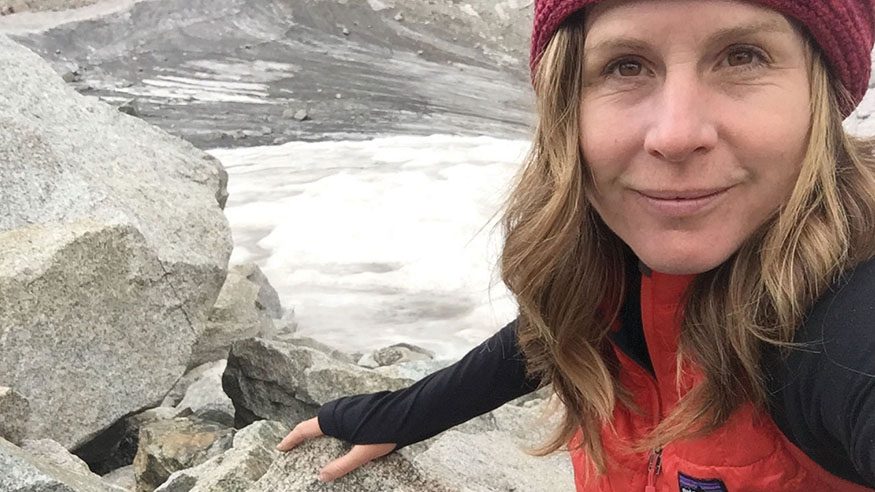
Amy Martin hiked to Isabelle Glacier in Colorado during her Scripps Environmental Journalism Fellowship year at the University of Colorado Boulder.
“But then, ironically I left, and I did music as a career for like 15 years,” she said.
After touring as a folk singer and recording CDs, she decided it was time for something new. All along she had been recording sounds other than music.
“I’ve also been kind of documenting my world in sound, because it’s just sort of what I’ve always done,” she explained. “I did a project where I recorded one minute of sound a day, every day for a year. I just wanted to do it. And I would record interviews with people as mementos to give as gifts.”
Music was storytelling, but she realized that she wanted to return to audio storytelling similar to her experience at WVIK. Then living in Montana, Martin started pitching stories to Montana Public Radio. Some of her stories ended up on NPR, which was gratifying, but not enough.
“I had to beg and fight to get my four and a half minutes…. I wanted to tell longer stories, deeper stories.”
About this time, the breakthrough podcast “Serial” was becoming popular for telling long-form nonfiction stories. Martin was listening.
“And I also felt like all of the majority of the stories I was hearing were taking place on the coasts, inside the studio,” she said. “And I wanted to get out and talk to people and be out in the world.”
And that’s what she has done.
“We’re all born into a calling, humming, chirping, howling ensemble of life on Earth… Lately, our species hasn’t been fitting into the group all that well.”
Martin’s career as an environmental journalist was kick-started when she won a one-year Scripps Fellowship in Environmental Journalism at the University of Colorado Boulder, which came with a salary. While there, she began what would be the first season of “Threshold,” a seven-episode exploration of the story of the American bison.
After that, it was on to the Arctic for the next season, to talk with the people in all eight Arctic countries about how they have been dealing with the effects of climate change.
The podcast’s next topic, a deep dive into the decades-long debate over drilling for oil in the Arctic National Wildlife Refuge, won a prestigious Peabody Award. Season 4, “Time to 1.5,” tackled the plan to limit global heating to 1.5°C.
Martin said the newest season of the podcast, “Hark,” investigates “what it means to listen to the nonhuman voices on our planet — and the cost if we don’t. With mounting social and ecological crises, we ask what happens when we tune in to the life all around us.”
In Australia she visits a unique bay where communities of microbes carry out some of the earliest known processes of creating life on Earth, and tries to imagine more than three billion years of silence before animals arrived. She listens to fish and learns how spiders hear.
As she makes her way through the sounds of the planet, her “Part of the Choir” episode explores how Homo sapiens joined the story of life on Earth 300,000 years ago, and the development of language and music. And listening.
Martin reflects in the podcast, “We’re all born into a calling, humming, chirping, howling ensemble of life on Earth… Lately, our species hasn’t been fitting into the group all that well. We’re way too loud and way off-key, but our voices do belong here, too.”
After “Hark” is finished in late November with its 16th episode, Martin will launch a new project on the podcast feed, an interview series called “Threshold Conversations.”
From the quiet hum of microbes to the harmonies of a college choir, Martin reminds us that listening — truly listening — is one of the most powerful acts of connection we have. And as “Threshold” continues to open new worlds of sound, Martin shows us that our place isn’t just to be heard, it’s to listen.
The Augustana Choir makes music by listening
Listen now: “Hark” – Augustana Choir
From the very beginning of her work on “Hark,” Amy Martin wanted to visit the Augustana Choir. It was while singing in the choir that she realized that producing a beautiful sound with others is not only expressive. It is equally receptive.
“We’re all sitting there in choir listening, listening, listening to each other, listening to ourselves, you know, fine-tuning volume and pitch and balance between all the parts, and it’s this deep, concentrated listening together,” she said.
“That, I think, is a huge part of what makes it such a bonding experience. Yes, we made beautiful music together, but what we did most is we listened together, so attentively. I just think there’s a magic to it.”
She contacted Dr. Jon Hurty, returned to campus and spent two days with the choir, listening to rehearsals and talking with students.
“Usually, when I go out to do reporting I’m not fighting back tears the entire time, but it was amazing to walk into Larson Hall, and just see the students filter in,” she said. “And when they started to sing, it just about knocked me over.”
During rehearsal, Martin hears Dr. Hurty focus the students on listening. He tells the sopranos and tenors to get a little quieter in a certain section to make room for other voices to be heard.
“This is the thing about listening, right?” he asks the students. “While we’re singing, we need to listen to the other parts. Because if you listen to the other parts, you’ll start to balance it.”
Martin reflects that the moment of instruction went by quickly, but was actually profound. The instruction he gives is simple: Listen.