
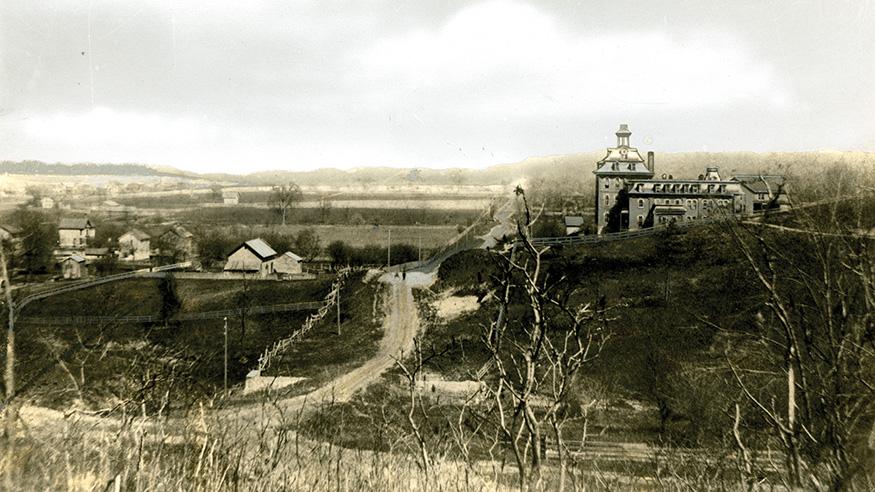
Looking east down Seventh Avenue, 1880s
Celebrating 150 years in Rock Island
Note: In honor of the 150th anniversary of Augustana’s first classes in Rock Island, the college’s unofficial historian Kai Swanson ’86 reflects on its early rural beginnings.
To see just how far Augustana has come, the photo above is First Building on Seventh Avenue, 1880s, surrounded by pasture and accessible by dirt roads. Below is the same location today, nearly 150 years later, with (clockwise) the Lindberg Center, Carlsson-Evald Hall, Old Main and Denkmann Memorial Building.
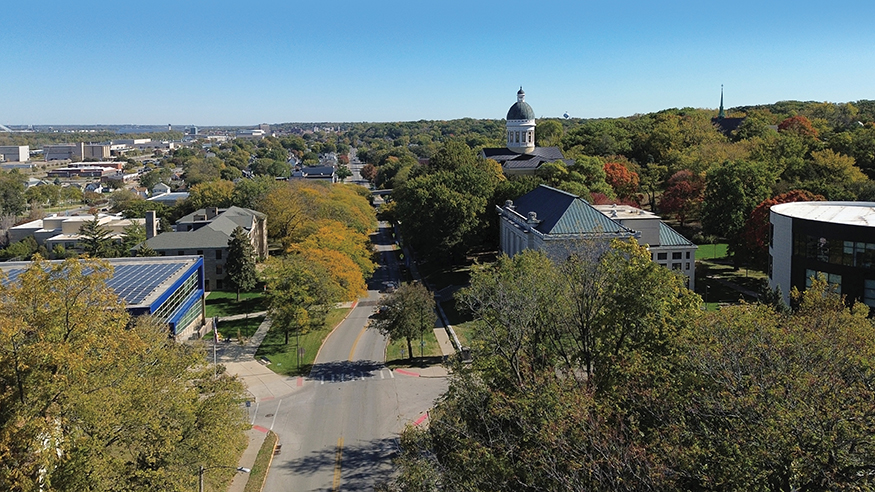
Looking east down Seventh Avenue, 2025
$50 donated to stop damage caused ‘by the feet and dirty deposits of cows’
By Kai Swanson ’86
By 1869, according to one college historian, “it was abundantly clear that no great future awaited a college” located in Paxton, Ill. This was unfortunate, considering Augustana had moved there in 1863. Something had to be done, and T.N. Hasselquist, the school’s president, knew it.
As word filtered out that a move might be in the offing, some folks in Geneseo, Ill., started talking about raising $40,000 to bring the college to their fair city. But the town council’s vision for Geneseo did not include a college, and so that talk was quashed. The Augustana Synod then empowered the board to accept any offers of land in Knox, Henry, Rock Island, Bureau and Cook counties, but no outright donations were offered.
Hasselquist appointed a committee to oversee the move, and chose a newly arrived professor named Henry Reck to chair it. Reck had moved to Illinois to help lead an orphanage in Jacksonville before being called to Augustana, where he was named head of the natural philosophy (science) department. Reck gets the credit for teaching the first science class in Augustana’s history in 1871, and went on to teach philosophy and English courses, as well.
Reck’s committee quickly learned of an intriguing prospect: 16 acres of land, midway between Rock Island and Moline, that could be had for the bargain price of $10,000. Adding to this was the excitement over resettling in a booming community with more than 3,000 Swedes living in the two towns. Work began raising pledges of support, called subscriptions, to move Augustana from the sleepy farm hamlet of Paxton to the bustling river town on the Mississippi.
Pledges, unfortunately, are no substitute for cash in hand, which was in short supply on Nov. 10, 1873, when a cornerstone was laid marking the site of the aptly named First Building. Not much more happened that day, since Conrad Bergendoff's history reported there wasn’t enough money even to dig the basement. Still, both fundraising and on Sept. 22, 1875.
Reck’s work was far from done, however, and at the end of the first school year, he updated the board on considerable progress in beautifying the “edifice” and its grounds: “This work of our hands is however constantly liable to damage and defacement by the feet and dirty deposits of cows.” Fortunately, a remedy was near at hand, thanks to a gift of $50 worth of lumber to build a fence, donated by a well-to-do neighbor, Frederick C.A. Denkmann.
Rock Island was, and remains, the perfect hometown for Augustana. While once home to the only rail bridge across the Mississippi, Rock Island and the Quad Cities remain well-connected to a much wider world beyond this curious bend in the river.
The first graduating class in Rock Island numbered six, two of whom were born in Sweden. Last May, Augustana celebrated more than 600 graduates, and a class representing Ethiopia, Morocco, Nepal, Vietnam and other countries.