
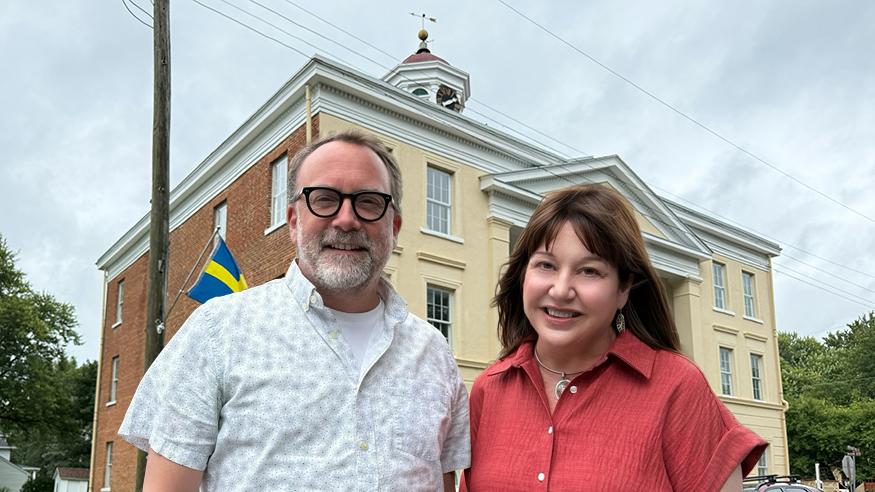
Dr. Adam Kaul and Dr. Margaret Farrar in front of Bishop Hill's Steeple Building, built in 1854.
Tiny town with big history lures professors into writing a book
In 2011, two colleagues at Augustana College hatched a plan over dinner to study a nearby historic village. They envisioned a short-term project.
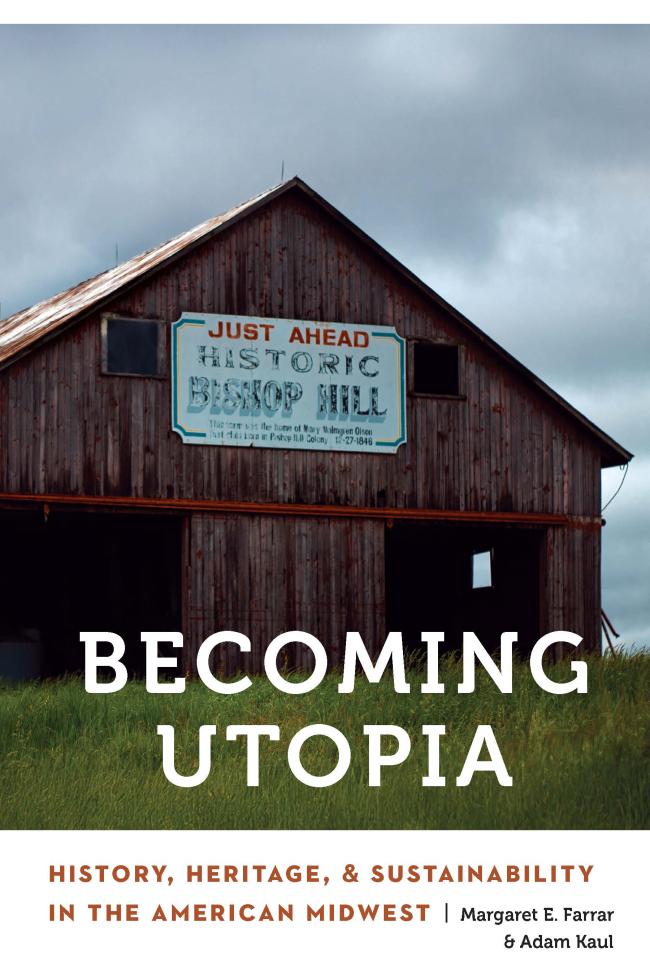
But the more they learned about tiny Bishop Hill, Ill., the more they wanted to learn. And so 15 years later they have published a book, “Becoming Utopia.”
Bishop Hill was founded as a religious colony in 1846 by Swedish immigrants. The colony disbanded in 1861, and its surviving buildings are listed on the National Register of Historic Places. Today Bishop Hill (pop. 120) draws some 80,000 tourists a year.
Dr. Margaret Farrar, now a professor of political science at John Carroll University in Cleveland, Ohio, and Dr. Adam Kaul, professor of anthropology at Augustana College, found their fields of study worked well together on the project.
“I got intrigued by Bishop Hill for obvious reasons,” Dr. Kaul said. “And then, Margaret and I just had this great kind of connection about it, and the cross-fertilization between our disciplines.”
Bishop Hill, roughly 50 miles southeast of the Quad Cities, is one of those places often characterized as “in the middle of nowhere.” Dr. Kaul had been there a few times, having heard about it as a pleasant place to visit.
One Christmas, Dr. Farrar was there for the annual Lucia Night at the 1848 Colony Church.
“It was one of those sub-zero Midwestern nights,” she said. “It was completely dark and freezing, and it was the most magical place. There was a concert in the church. It was just gorgeous. It was otherworldly.”
Living with history
Though its claim to fame is its history, Bishop Hill is still a place where people live, and the two scholars wanted to see the whole picture of the town.
“I got intrigued by Bishop Hill for obvious reasons.”
Over the course of many visits over several years, Dr. Kaul and Dr. Farrar each immersed themselves in the community. Dr. Kaul lived there for two weeks. They interviewed residents, spoke with tourists, listened to everyday conversations, and explored archival and historical records.
To present the full picture of Bishop Hill, they found themselves edging into “other people's methods,” Dr. Kaul said, such as history, Scandinavian studies, art history and literature.
Dr. Farrar, who previously had written a book about urban planning in Washington, D.C., noticed how the residents negotiated living in the town while also honoring its original plan.
“It's not just a museum piece,” she said. “It's a place where people actually live and work and eat. And have town hall meetings, and get their mail and go to the grocery store.
Her writing is about the stories people tell about places. Some of the many stories told about Bishop Hill don’t exactly match its history, they found.
One, that the immigrants left Sweden to escape religious persecution.
True, however, that the group had become antagonistic and provoking to their government and church before leaving Sweden, Dr. Kaul said.
Two, the land they settled was empty because Native Americans had left.
Not really. Records and accounts from the 1850s often mention Native Americans in the area, and the Black Hawk War was not too far away in time or distance.
Heritage vs. history
During their study, the Bishop Hill of past, present and future collided when a wind farm project was proposed there. Residents who supported tourism protested that the turbines would mar the bucolic view. But, in the end, more than 200 turbines were built from 2012-2018.
“That was one of the most interesting parts of the research,” said Dr. Farrar. “It's a grieving process to go through losing your landscape and your view, and your understanding of the place.”
The pros and cons of the wind farm didn’t neatly map onto political parties, nor did most of the other issues they heard about.
But they witnessed plenty of debate.
“You don’t need research to discover this, but Bishop Hill keeps reinventing itself.”
“There’s the whole idea of heritage versus history,” said Dr. Kaul. “Remembering what actually happened in the past, the dates and names, and a version of history versus how people remember it.”
Dr. Farrar said that, over and above politics, is the survival of the town.
“It really is this tiny little entity that has to continue to make itself relevant and interesting,” she said. “Historic buildings don't take care of themselves. They need funding, and so the sort of traditional left-right politics are less important than ‘How do we make it to the next year?’”
Funding for Bishop Hill has gone up and down over the years, and both writers said they hope it will grow.
“You don't need research to discover this, but it keeps reinventing itself,” Dr. Farrar said. “The people who move there, especially to participate in the maker community or the heritage tourism community, are incredibly entrepreneurial and creative people.”
A case study
Dr. Farrar and Dr. Kaul both are Midwesterners. Could non-Midwesterners have written “Becoming Utopia”?
“The question is, would they want to?” asked Dr. Farrar. “Our whole point is that this place, like any place, is multi-layered and diverse and plural and interesting. You can see lots of different things in it. If you have the bias of ‘It’s all flyover country,’ you might not want to explore that richness.”
The writers think of their book as a case study for people in other communities to look at how one small town continues to survive.