
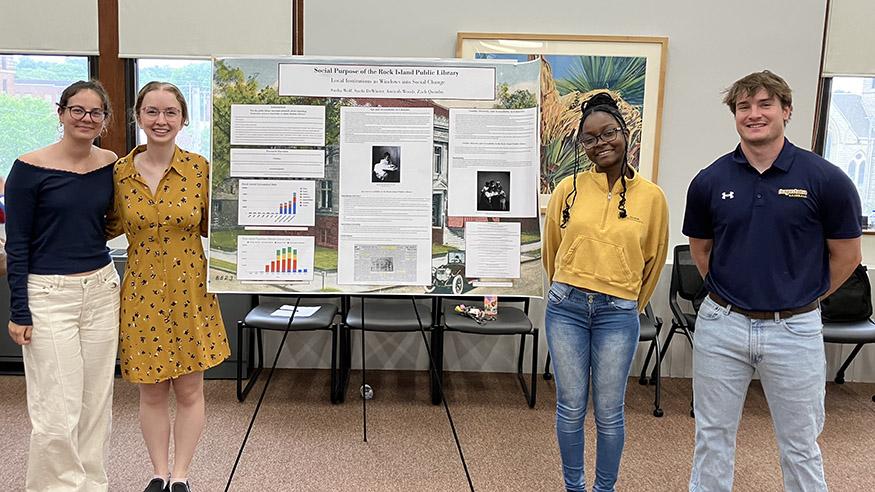
Students in Dr. Jane Simonsen's History 300 class, including Sasha Wolf '28, Sachi DeWinter '28, Amiyah Woods '28 and Zach Quimby '28 (above), presented their findings to the community after researching the history and contributions of Rock Island's Downtown Library.
Augustana history students dig into the past to support local library's future
A semester studying the history of the local library might seem like a bit of a snooze.
That is not how students in Augustana’s History 300 class found it last year. In the spirit of true researchers, they uncovered:
The Rock Island Library started out as private, not public.
The first librarian started at age 16 and never left.
The Red Cross was housed there in WWI.
And students kept asking questions, some of which they could not answer:
What were the lives of the laborers who built the library in 1903 like?
Was there an informal racial segregation in some periods?
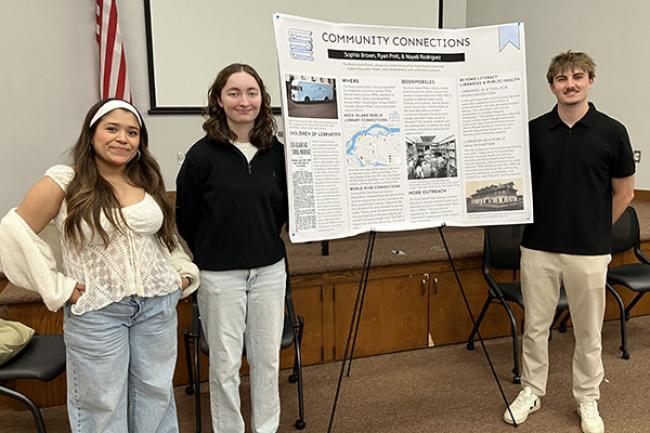
The research findings of Nayeli Rodriguez '28, Sophia Brown '29 and Ryan Prell '28 show the 123-year-old Downtown Library to be a cornerstone of the Rock Island community for public health, child development and community outreach.
Their project came about when the Rock Island Public Library asked for help compiling historical information about the downtown library, and called on the services of the Augustana Accelerator.
The Accelerator, through the Upper Mississippi Center for Sustainable Communities, puts students and faculty in touch with community needs. In this case, the library wanted historical background for its master plan and eventual capital campaign.
Past college-community partnerships generally have involved students in STEM fields. But this time humanities students found a role, facilitated by Dr. Jane Simonsen, professor of history, and a small grant from the college to cover field research trips.
History 300 is required for history majors and teaching history majors. The class project each year varies. The class goals include learning research methods and becoming familiar with Midwest history.
“Focusing on the Midwest allows us to use Special Collections and focus on some of the things we have here, so that students can do more hands-on stuff rather than finding sources online as much, although we teach them how to find good sources online, too,” said Dr. Simonsen.
Since most of the students already will write a long paper as part of their Senior Inquiry project, Dr. Simonsen sets up the History 300 project in a different way. In recent years, they have made documentary films, websites and podcasts.
So when the library staff said they were looking for someone to dig into library history, possibly for an exhibit, Dr. Simonsen was on board.
“Working with the students was a pleasure and helping them learn about historical records and the research process aligns perfectly with the library's mission. We would be thrilled to partner with Augie again!”
Putting local history on display
In addition to topics the library staff wanted to know more about, students also picked topics that interested them, such as the material used to build the library. Then they wondered about where the materials came from, and the laborers who built the library. Little could be found about those people.
“That's instructive for the students, too, to find out that laborers are often anonymous in our history,” Dr. Simonsen said.
Their work was distilled into a poster session for community members last May. The library retained copies of each poster in its local history collection for its own storytelling, said Karrah Kuykendall, library adult services coordinator.
“The students we worked with were engaged, curious and passionate about the project,” she said. “Working with the students was a pleasure and helping them learn about historical records and the research process aligns perfectly with the library's mission. We would be thrilled to partner with Augie again!”
Creating posters worked out well for the History 300 class, which requires students to demonstrate the ability to present visual images and data visualizations, such as a chart, graph or map.
“We were excited that their research didn't just stay on campus, but actually got in front of the community,” said Dr. Simonsen.
“This type of approach is what really got me to attend this college,” said Ben Linden '28 from Western Springs, Ill., who plans to teach history in high school. “This class gave me a proper experience of researching and going out into the local community to discover the origins and history of the community, a skill I can most certainly apply later in life.
“For example, I went to the library with my research group, and we found 1903 manuscripts about the certain type of stone that was used to build the library, which was important to our research.”
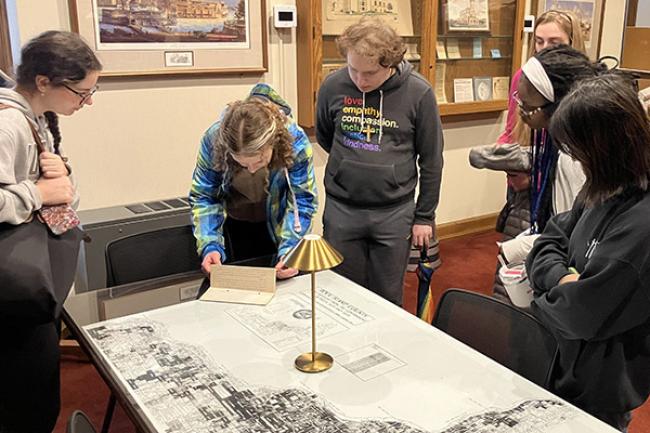
Students studied dozens of documents, photos and newspaper articles archived at the Downtown Library.
Excited about helping the community
Emily Swanson '27 of Thomson, Ill., wanted to attend a small institution and was attracted by Augustana’s Scandinavian studies and Swedish language instruction.
“History 300 offered us the chance to work on a real-world research project that will help our community,” said Swanson. “I did not expect this, and as someone who has worked for a public library, I was very excited about this opportunity.”
Her career goal is to work in the field of MIA repatriation, so she values the research skills she learned in the class.
History 300 was the first Augustana class for Sachi DeWinter '28, a transfer student from Muscatine, Iowa, and she was a little nervous.
“I ended up really enjoying the course," she said. "It offered a chance to develop different research skills in history in a setting that gave us a lot of independence but also had Dr. Simonsen there to offer support when we struggled."
DeWinter appreciated the focus on local history. “We looked at historical trends such as child welfare, architecture, and building materials, while also seeing how the library's specific history fit, or didn't fit, into those broader categories.
“Not only did I learn about how to use different avenues of research, such as physical archives, online photo databases, digitized documents, and census records, but I also saw that despite all these tools, finding information still requires a lot of persistence."
DeWinter is interested in working in historic preservation, although she’s keeping her options open.
Finley Snyder '29 from Rockford, Ill., plans to become a pastor. They said the skills they gained in this course will be invaluable.
“Historians are trained to always ask the tough questions, and one of the first questions you learn to ask is: What's the source for that? In our research project I went in expecting to find one thing but the evidence showed something completely different. This was incredibly exciting, it meant we were learning something new and challenging our own expectations.”
They gained a newfound respect for those who work to preserve the historical record.
“You spend so much time in the research process wishing for more sources or bemoaning the quality of the sources you have,” they said. “So often I thought, ‘I wish these people wrote more things down!’”