
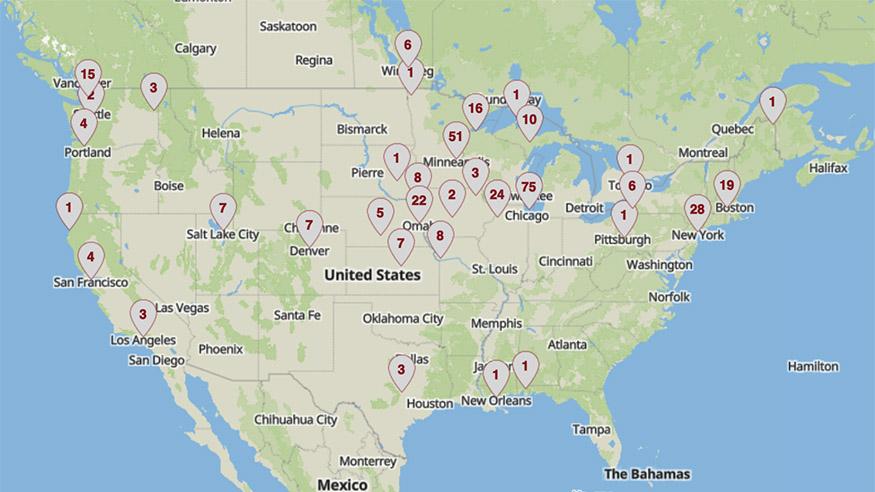
All are welcome to visit Browse by Map and click on the numbers to see the Swedish-American newspapers in that area. Not surprisingly, the middle of the country, where many immigrants had settled, has the highest concentration of the publications.
Augustana helps build searchable digital archive of Swedish-American newspapers
“Students everywhere can use the database, free of charge. My students at Uppsala are very excited and will write many papers based on the database. Augustana students can do the same.”
Once a year, a heavy crate of newspapers arrived on the doorstep of the National Library of Sweden in Stockholm.
Starting in about 1860 and continuing for decades, these newspapers were sent by Augustana College to help the library with its mandate: to collect and archive all Swedish language publications.
The library had been collecting a copy of everything published in Swedish since 1661. So when Swedish immigrants to the United States began publishing newspapers in their native language, the librarians in Sweden took note. They asked Augustana College to be their agent. Augustana said yes.
At the time, Swedish-American newspapers were popping up all over the United States, especially in the Midwest, where many immigrants had settled.
Those newspaper publishers could hardly have imagined today’s newly launched digital Swedish American Newspapers Project, which puts more than a million pages of their history at readers’ fingertips.
This free resource includes 348 publications whose pages were digitized thanks to the efforts of partners in the two countries, including the Minnesota Historical Society, Kungliga biblioteket (National Library of Sweden), the American Swedish Institute, and Augustana College’s Swenson Swedish American Research Center.
A historical leap forward
Scholars, students, genealogists and everybody else can search by the name of the publication, keyword, date and location. The collection covers 1851-2007. Results can be translated into English.

Dr. Dag Blanck '78
“It is a tremendous resource,” said Dr. Dag Blanck ’78, director of the Swenson Center and a professor of history at Uppsala University in Sweden. “Many new questions can be asked by students and scholars, and our understanding of Swedish-American history takes a qualitative leap forward.”
“Students everywhere can use the database, free of charge,” he added. “My students at Uppsala are very excited and will write many papers based on the database. Augustana students can do the same.”
And they will. Dr. Mark Safstrom, associate professor of Scandinavian studies at Augustana, will use the newspaper database in his course on immigration history.
He recalled as a graduate student himself in Sweden, searching through files of newspaper clippings for research, and then lugging home photocopies in his suitcase.
No need for that now.
“You can find a needle in a haystack if you know the right keywords,” he said.
Although the primary use of the newspaper archive may be for genealogy or academic research, there is much more, said Dr. Jonas Björk, visiting professor of Scandinavian studies at Augustana, author and journalist.
“Because in these pages you find everyday stuff,” he said. “They would record who had a birthday, who had a surprise party, who was sick, who was traveling, who had guests from out of town. So it is a fuller image or picture of what life was like.”
The digitization project began in 2011. The work was done at a facility in northern Sweden (where there were breaks in the work to allow for the moose hunting season). The computer files then were transferred to Minnesota, where they were “ingested” in the search platform at the Minnesota Historical Society, ready to be used.
"In these pages you find everyday stuff. They would record who had a birthday, who had a surprise party, who was sick, who was traveling, who had guests from out of town. So it is a fuller image or picture of what life was like.”
Where the Swedes are
To look at the locator map of where all the newspapers were published is to see where most Swedish immigrants took root: mainly the Midwest.
Historians often talk about Swedish America having two capitals: Chicago and Minneapolis. But the Quad Cities also stands out with nine publications in the database and another eight in nearby Illinois counties.
“Whenever there were enough Swedes you could hope to publish a newspaper,” Dr. Björk said.
During the first phase of the project, newspapers from major cities were digitized. Then as more funding was found, the librarians added small-town publications, such as the Moline Tribune (1910-1915).
Jill Seaholm, head of Genealogical Services at the Swenson Center, found an article about her grandfather's death. He was a factory worker who fell ill at work and died on the way to the hospital.
The news wasn’t in the Moline Tribune, because his death occurred after it ceased publication. But since the digitization project had the funding to upgrade and extend into more years, Seaholm did find an article about his death in a later Chicago newspaper.
“It has extended far enough forward with this new upgrade to include more, so the results are going to be amazing for genealogists and students and academics,” she said.
Fortunately for this project, the Swedish immigrants prized their newspapers. They believed reading multiple newspapers helped understand different perspectives.
An excerpt from the Skandia (Moline, Ill.) Dec. 1876:
“Every Swedish American family, who has the means and opportunity to do so, should, in our opinion, honestly keep not one but several newspapers, because through the study of several such, one-sidedness in views and in criticism is prevented and a deeper insight into affairs is gained, since these are thus seen from different sides.”